
Moody's Ratings on Tuesday said India has a lower overall exposure to the US relative to others in the APAC region, although certain sectors such as food, textiles and pharmaceutical products face risks. Moody's said most companies in its rated portfolio are domestic-focused with limited exposure to the US market.

The Indian government has expressed its disagreement with the IMF staff's 'baseline' assumption that the 50 per cent US tariffs on its goods exports 'would remain in place indefinitely', based on which the staff pegged the country's GDP growth at 6.6 per cent this year, and pared its 2026-27 projection by 20 basis points to 6.2 per cent.

'I think today RBI supervision is much sharper than what it was earlier.'

'The statistical confidence bands of the fan charts of the forecasts will provide a better sense of the potential variability of outcomes.'
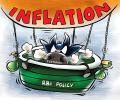
Amid a debate on the basis of a monetary policy stance, one may be curious enough to know how non-food retail inflation has behaved over the years in India. Let the eager souls catch a glimpse of facts. In the past 10 years, non-food inflation came down below 4 per cent on two occasions - pre-Covid period of 2019-20 and now in the first four months of the current financial year (FY25).

'...not merely in managing fiscal mathematics, but in demonstrating conservatism and prudence within that framework.' 'Looking forward, we believe sufficient growth drivers exist -- ranging from government reforms to revival in consumption to favourable monsoons. Numerous factors support the Indian economy.'

While the new income tax law replaces the Income Tax Act, 1961 and omits 13 offences, 35 actions and omissions continue to attract criminal liability under 13 provisions.

Finance Minister Arun Jaitley on Saturday said that retail inflation is expected to remain close to 5 per cent

With the setting of MPC, the interest rate setting powers would move from RBI Governor to the panel.
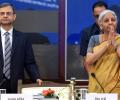
Sanjay Malhotra takes charge as the 26th RBI governor at a time when headline retail inflation has shot up to 6.2%.

'Other sectors that manage the savings pools of Indians are giving tough competition to life insurance companies.'

The central bank should be made responsible for delivering on an inflation target.

As a protege of Shinzo Abe, Takaichi is expected to scale bilateral ties much higher. Trade and investment shall grow. People-to-people contacts shall be scaled up, points out Dr Rajaram Panda.

The RBI under former governor Shaktikanta Das resisted pressures to cut interest rates through 2024 as it kept its 'Arjuna's eye' trained on inflation, but the central bank under a new detail-oriented head will soon have to take a call if it can continue sacrificing growth. Das, a career bureaucrat who in 2016 oversaw Prime Minister Narendra Modi's highly disruptive demonetisation move, left a lasting legacy as he demitted office towards the end of 2024 after expertly navigating monetary policy for six years, the highlight of which was steering India's recovery through the pandemic.
The Urjit Patel committee on monetary policy framework has proposed setting up of a monetary policy committee (MPC) that will be headed by the Reserve Bank of India (RBI) governor and accountable for achieving inflation target set by it.

Policy with regard to the foreign banks is part of his five pillars of reforms, says RBI Governor.

The final and most significant reset in the relations between the government and the RBI is the manner in which the process of appointing the governor and deputy governors of the central bank has been changed.

Andhra Pradesh will establish two expansive integrated space cities in Lepakshi and Tirupati, spanning around 33,000 acres.

India's annual oil import bill could rise by $9-11 billion if the country is compelled to move away from Russian crude in response to US threats of additional tariffs or penalties on Indian exports, analysts said. India, the world's third-largest oil consumer and importer, has reaped significant benefits by swiftly substituting market-priced oil with discounted Russian crude following Western sanctions on Moscow after its invasion of Ukraine in February 2022.

The panel was set up to suggest ways to reform India's monetary policy.
The government has invited applications for the post of deputy governor of the Reserve Bank of India (RBI) from interested candidates with at least 25 years of experience and below 60 years of age as on January 15, 2025. One of the deputy governors, Michael Patra's current term will end on 15 January. The last date of submission of applications is November 30, 2024.

Sahil Kapoor of Edelweiss Retail Capital Market Research says that setting up a monetary policy committee should have been the first step. And the central bank could have moved towards a formal inflation targeting mechanism after the processes and data sets are in place.
Referring to the proposed new monetary policy framework, it said in the weeks ahead, government and RBI will work towards it.
The committee set up under Urjit Patel to revise the policy framework needs to re-examine the Reserve Bank's approach to monetary stability.
Reserve Bank of India (RBI) Governor Sanjay Malhotra on Wednesday said regulations should not create unintended barriers to financial inclusion while emphasising that the impact of regulations on individuals and businesses should be considered.

'A possible post-election growth momentum may be lost.'
Focus on inflation, higher CPI projection dampen bond market mood.

Crypto assets should not be granted official currency or legal tender status, the much-awaited synthesis paper by the International Monetary Fund (IMF) and Financial Stability Board (FSB) has said ahead of the G20 leadership summit under India's presidency. However, the report has argued against a blanket ban on activities linked to crypto assets, explaining that such a move can be costly as well as technically demanding to enforce. Central banks should avoid holding crypto assets in their official reserve as they pose a risk to monetary and global financial stability, according to the synthesis paper.
The Reserve Bank on Wednesday retained the retail inflation projection at 4.5 per cent for fiscal 2024-25, with Governor Shaktikanta Das stressing that the central bank will have to closely monitor the price situation and keep the "inflation horse" under tight leash lest it may bolt again. Unveiling the October bi-monthly monetary policy, the Governor also said the flexible inflation targeting (FIT) framework has completed 8 years since its introduction in 2016 and is a major structural reform of the 21st century in India.
The long-term answer lies in getting the central bank to focus on inflation.
.jpg)
Food and fuel inflation in India have remained high for several years, the paper said, adding to durably reduce the current high inflation, the monetary policy stance needs to remain tight for a considerable length of time.

India will oppose the World Bank funding to Pakistan next month, arguing that Islamabad has used such funds in the past to procure arms and ammunitions. India previously lobbied against the IMF extending a USD 2.3 billion assistance to Pakistan earlier this month, presenting evidence of Pakistan's misuse of funds for military purposes. India feels that Pakistan has failed to act on terror emanating from its territory and has been diverting funds from multilateral agencies to buy arms and ammunition.

User protection and a proposal for a licensing framework for companies seeking to operate in the cryptocurrency area will be part of an upcoming consultation paper on the sector, said a senior industry executive. Even as specific regulations around crypto are yet to take shape, companies are setting up baseline user protection processes, including a redressal mechanism, fraud detection, regular filing of suspicious transaction reports (STRs), among others.

The government had amended the RBI Act through Finance Act 2016.

Manufacturing activities in India remained robust and price pressures were contained in October as new orders and production rose at a slower but stronger pace, according to a monthly survey released on Tuesday. The seasonally-adjusted S&P Global India Manufacturing Purchasing Managers' Index (PMI) was up from 55.1 in September to 55.3 in October. The October PMI data pointed to an improvement in overall operating conditions for the 16th straight month.

The Reserve Bank's rate setting panel on Thursday met to finalise a report for the government on why it failed to keep retail inflation below the target of 6 per cent for three consecutive quarters since January this year, said sources. The report will be presented to the government as per the Reserve Bank of India Act, they added. The six-member Monetary Policy Committee (MPC) is headed by Governor Shaktikanta Das.

The RBI said there is an upward bias on inflation projection.
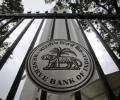
At least a 25 basis points hike can be expected on the October 5 policy

India has decided to submit a dossier at the upcoming Financial Action Task Force (FATF) meeting, calling for Pakistan to be placed back on the grey list of the global money laundering and terrorist financing watchdog.

A three-year validity of an inflation target is, perhaps, more reasonable and practicable.
 © 2026 Rediff.com - Advertise with us - Disclaimer - Privacy Policy - Sitemap - Feedback - About us - Terms of use - Grievances